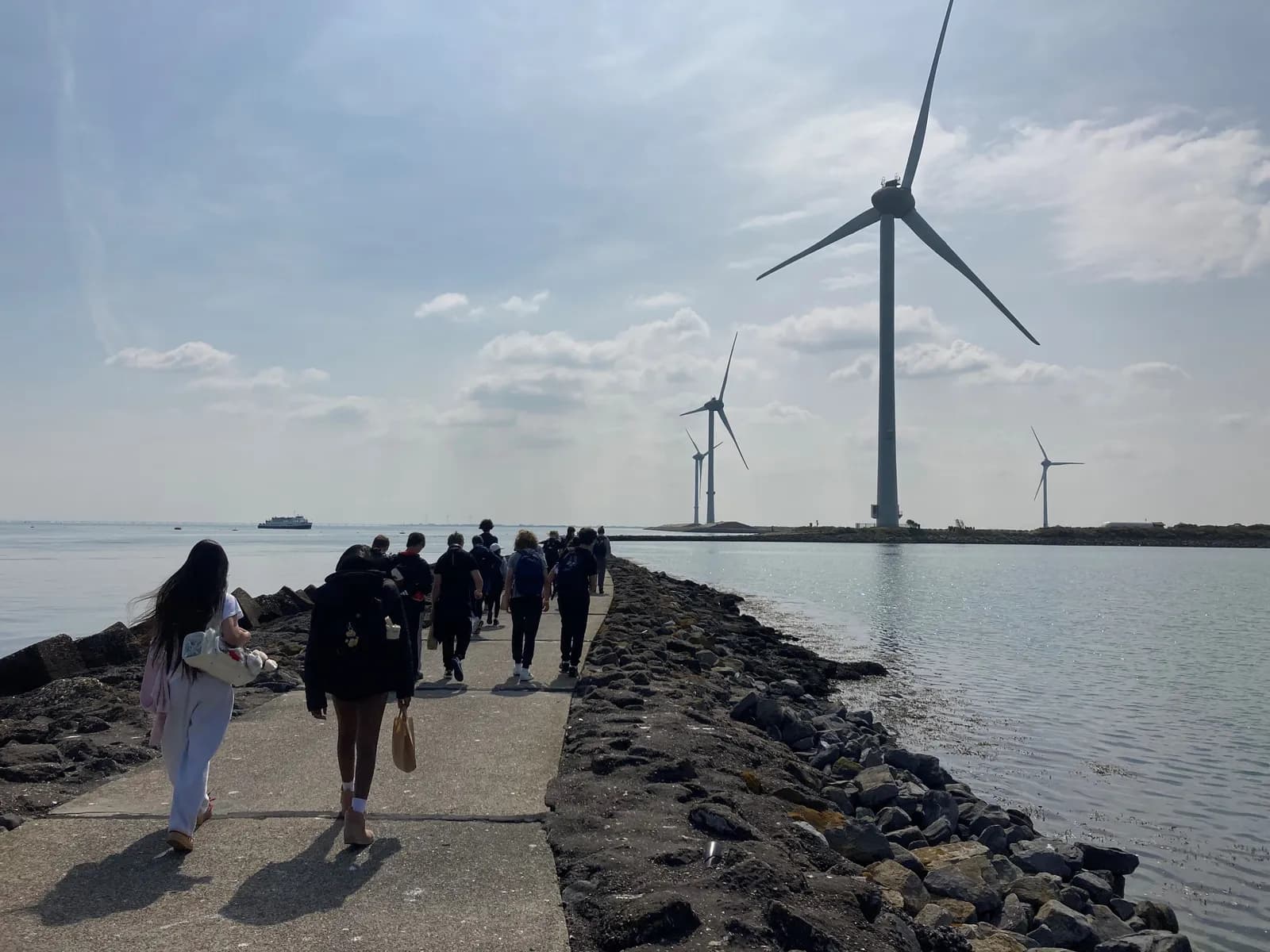
Students from Greenshaw High School in Sutton have taken their geography learning beyond the classroom with a school trip to the Netherlands, combining visits to major engineering projects with cultural experiences and time spent together as a year group.
The trip, organised with the support of Rayburn Tours, gave students the opportunity to see geographical concepts they had studied in lessons first-hand, while also experiencing Dutch culture and exploring the country as a group.
Led by Party Leader and Deputy Head of Geography Adam Barnes, the tour included visits to the Maeslant storm-surge barrier and the wind turbines at Neeltje Jans, as well as cultural activities in Amsterdam and a day at Walibi Theme Park.
One of the main aims of the trip was to help students make connections between their classroom learning and the geographical features and infrastructure they were seeing in person.
Adam comments:
The first was seeing students experience things they had previously only seen in a Geography classroom. Standing underneath the enormous Maeslant storm-surge barrier and getting up close to the wind turbines at Neeltje Jans, you could see them making those connections between what we had taught them in school and what was actually standing in front of them. It brought their classroom learning to life in a way that is very difficult to replicate at school.
The visit to the Maeslant storm-surge barrier introduced students to the ways the Netherlands manages the risks associated with coastal flooding. At Neeltje Jans, the students were able to see wind turbines at close range and explore renewable energy in the context of the Dutch landscape.
Although geography was central to the trip, the itinerary also gave students the chance to experience aspects of Dutch culture and everyday life.
The group explored Amsterdam by canal, learned how traditional clogs are made and sampled local cheese, adding a cultural dimension to the geographical visits.
Adam says:
I think the Netherlands is a brilliant destination for a school trip because you can fit so much variety into a relatively short amount of time. It is close enough to the UK that travelling by coach and ferry is manageable, but once you arrive it feels like students are genuinely experiencing a different country and culture.
The mixture of educational and cultural activities also meant that students had opportunities to enjoy the trip outside of their geography lessons.
Adam adds:
What I particularly liked was that the trip didn't have to be Geography from morning until night. We could mix those educational visits with experiences such as making clogs, tasting cheese, seeing Amsterdam from its canals and having a full day at Walibi. That variety meant there was always something different for the students to look forward to.
One of the most memorable aspects of the trip came during the evenings, when students had the opportunity to spend time together away from their usual school environment.
In the evenings, the students fashioned a makeshift football pitch at our accommodation and would all go out and play together. We’re one of the largest schools in the South East, with over 300 students in Year 9, so many of the students on the trip probably hadn’t even spoken to each other before we left. A couple of days later, they were out there playing football together as if they’d known each other for years.
- Adam says.
Reflecting on what the trip meant beyond the geography curriculum, Adam comments:
For me, that summed up another really important part of taking students away: the experiences and friendships they come home with, as well as everything they’ve learned.