For more than two centuries, the fields around Sutton produced enough lavender to earn the area its title as the "Lavender Capital of the World." The industry dominated local agriculture from the 18th century until the early 20th century, when suburban development brought the era to a close.
The Rise of a Global Industry
The chalky, free-draining soil of the North Downs proved ideal for lavender cultivation, and by the 18th century, commercial growing had taken hold across Carshalton, Wallington and Beddington. The Daily News reported in 1914 that at Carshalton Beeches, "in every direction the low hill sides of the farm beyond Beeches Halt are swept with the bloomy pastel tint of the lavender flowers." Wallington was described as "an important centre for the production of lavender oil" until the First World War, with the area to the north of the station chiefly given over to cultivation.
The Farmers Behind the Fields
One prominent figure in the trade was John Jakson, who farmed lavender at Little Woodcote Farm. His contribution to local history is remembered today in the name of The John Jakson public house on Woodcote Road in Wallington. Commercial operations extended across the district, with the industry described as "a very prosperous part of the local agriculture" throughout the 19th and early 20th centuries.
Decline and Transformation
The industry's decline came "about the time of the First World War," according to historical records. The primary cause was straightforward: "the increasing land demand for residential building put an end to commercial growing." As suburban housing expanded across the former fields, the blue-purple landscapes that had defined the area for generations disappeared beneath roads and houses.
A Living Heritage
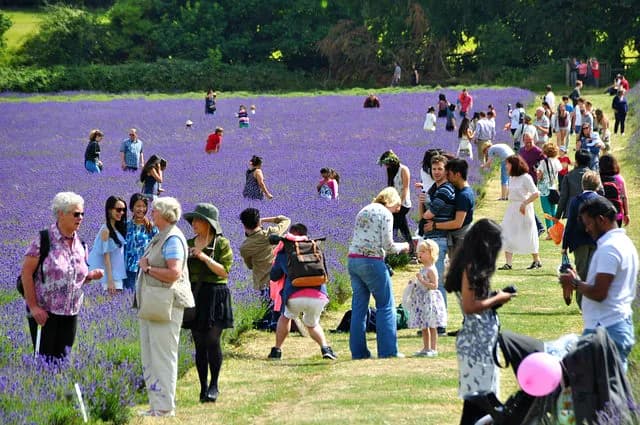
Today, traces of Sutton's lavender past remain visible throughout the borough. The Mayfield Lavender Farm at Croydon Lane in Carshalton South and Clockhouse ward maintains 25 acres of commercial cultivation and draws tourists each summer. A three-acre community project at Oaks Way, Carshalton Beeches, operates on a not-for-profit basis. The Guy Portelli sculpture "English Lavender," installed in 1999 at the junction of Woodcote Road and Stafford Road in Wallington, commemorates the district's agricultural history. Local Scouts wear lavender on their Sutton area shoulder badges, and Wallington's Christmas lights are shaped to represent lavender plants. Blue fields may no longer stretch "in every direction," but the scent of history lingers in Sutton's streets and place names.